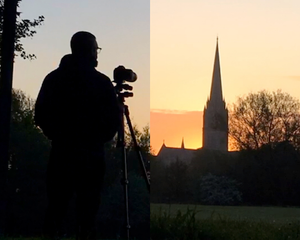
Reading the words of Victorian polymath, John Ruskin taught me another way of seeing. By taking the time to work out the impact and movement of light as an artist would, I could begin to orchestrate a better composition.
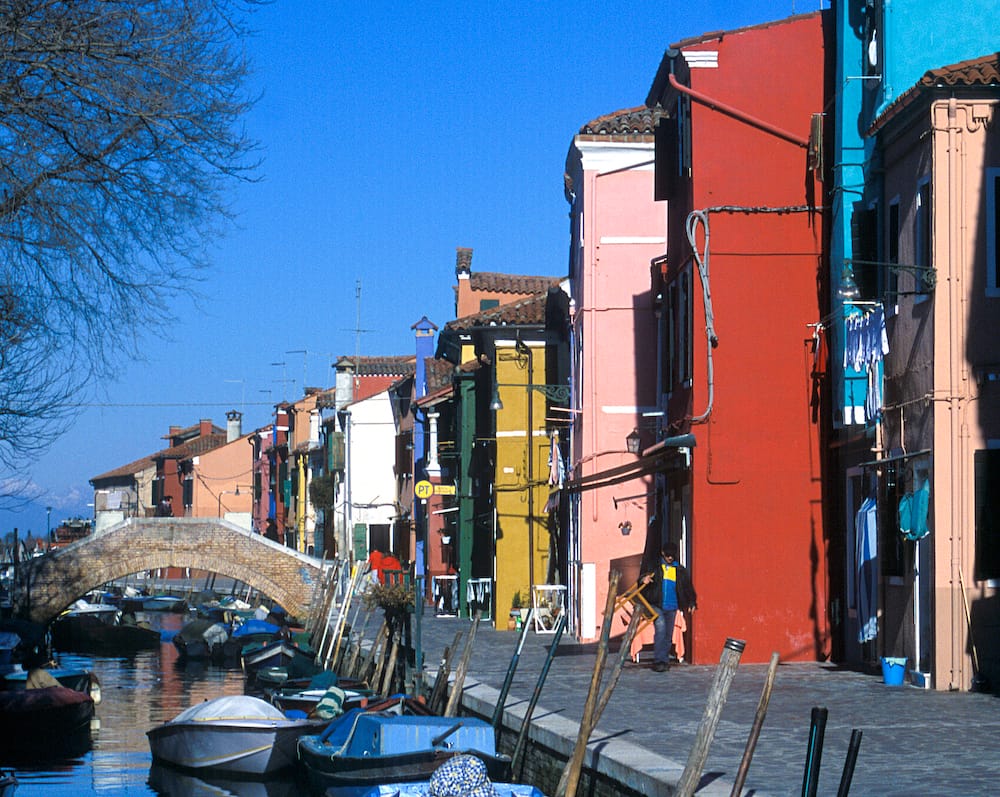
These colourful facades were some distance away. I was sitting on the edge of a canal, with the lapping sounds of the Venetian lagoon beyond. It was a bright, cold, crisp day. I used a 300mm lens to draw in the perspective.
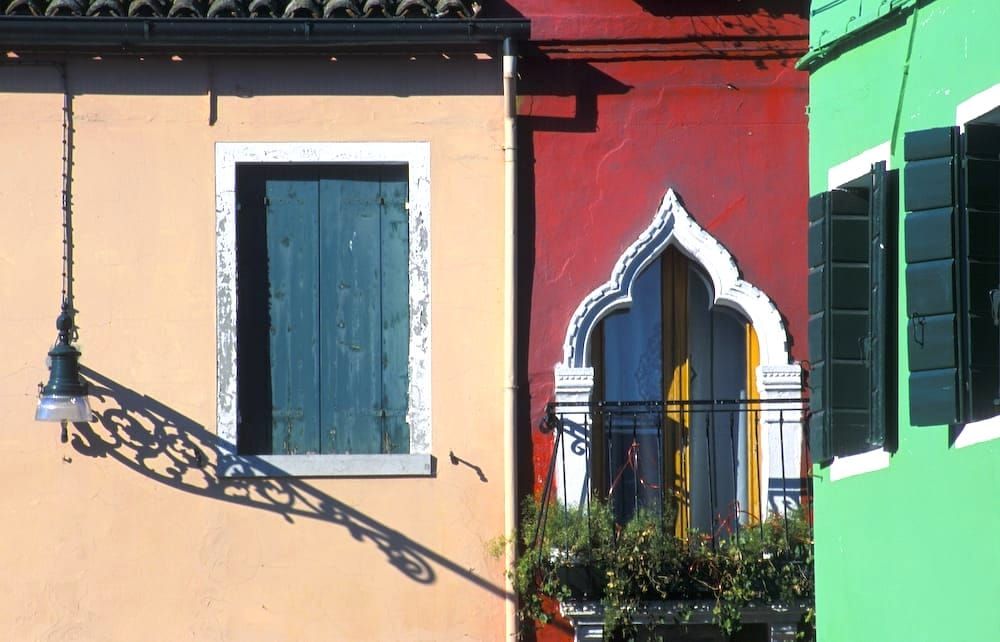
The zoom lens enabled me to include and exclude parts of the facades, so much so that I could form a kind of visual trick - a triptych of planes, colours and surfaces. I fired off a few shots, but there was something missing. The composition was too perfect - banal, perhaps.
Then I noticed a shadow beginning to form from the bracketed lamp. I calculated that, if I waited long enough, the shadow would cut into the composition and add a new dynamic to the image. I set my watch, came back an hour later, then waited another fifteen minutes before capturing the final photograph.
It was only afterwards, through looking again, that other possibilities began to emerge.
There are two openings within the composition. One is closed and resolutely flat, its shutters shutting us out completely. The other is open, elaborate and ornate, sitting beneath an ogee arch which seems to promise entry into another world. And yet this opening is partially shielded by what appears at first to be a flat pane or surface.
The longer I look, the less certain that surface becomes. What first appears solid begins to feel permeable. There are layers beyond it - reflections, shadows, glimpses of colour and perhaps the suggestion of an interior. The eye is allowed through, but never entirely. There is mystery beneath the ogee arch.
I like that tension between the two openings. One refuses us completely; the other invites us in but withholds something. The photograph becomes less about three colourful Venetian facades and more about different kinds of access - what is revealed, what is concealed, and what we imagine.
Even the shadow seems to participate in this. It is not part of the architecture itself, yet for a few moments it becomes another piece of ornament, stretching diagonally across the wall and disrupting the order I had originally tried to impose upon the composition. It feels like the hands of a clock - measuring the moment that time stopped with the click of the shutter-button.
What looks at first like a picture of three flat facades slowly becomes something else: a photograph about openings and barriers, surface and depth, concealment and revelation and, of course, time and its continuous movement.
Connect with me on: Bluesky / Instagram / Facebook / X / Tumblr / Flickr / Vimeo / Pixelfed / Pinterest
Member discussion