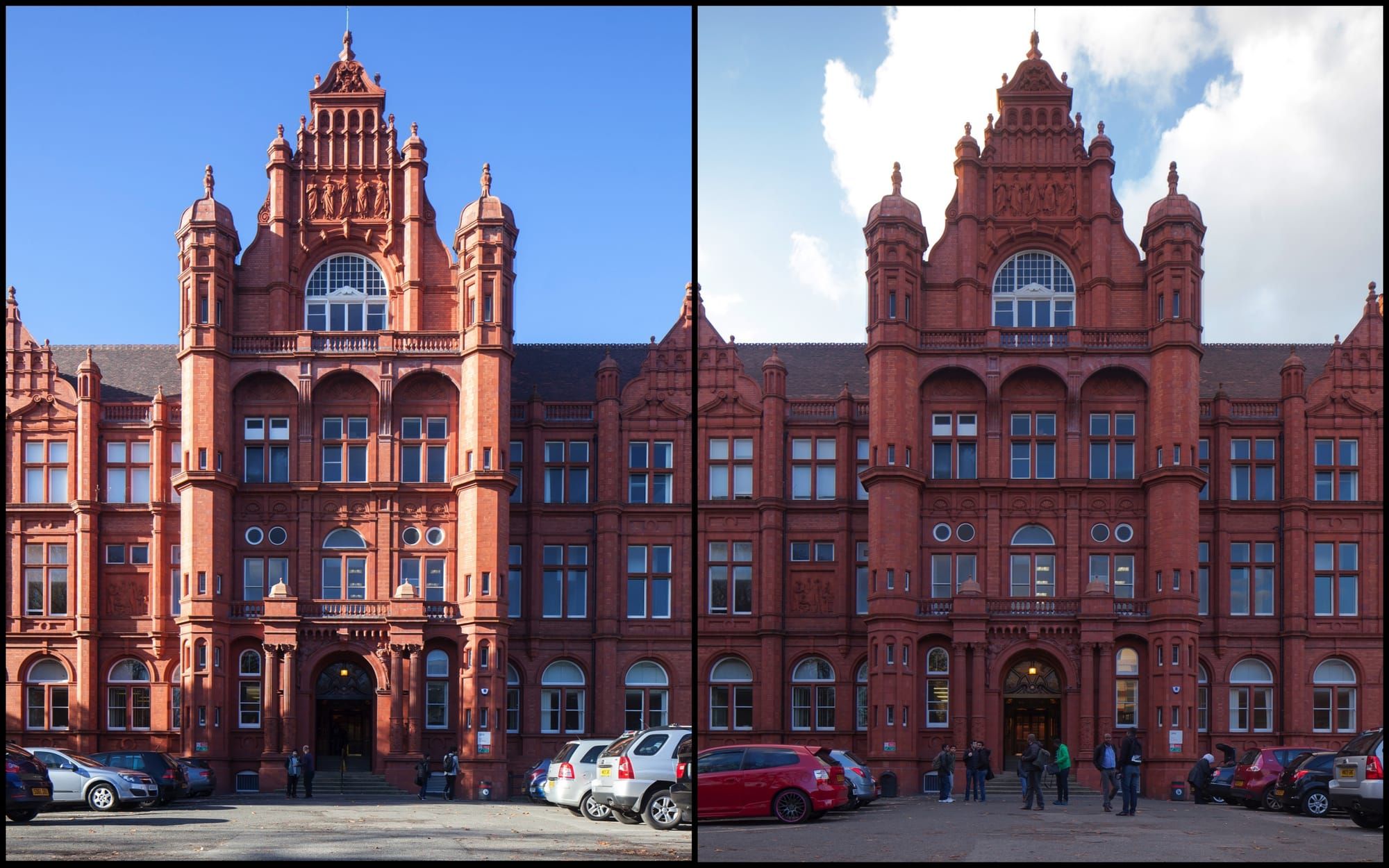
I passed the Peel Building at the University of Salford every day while photographing the progress of a Bunker House project for Saint-Gobain. My attention was fixed upon the job in hand and, under a succession of cloudy skies, I barely noticed the brick and terracotta building as I passed it by.
On the final day, raking sunlight struck the facade at such an angle that it pricked out every detail. The brick fizzed, the recesses deepened and the mouldings separated themselves from the mass. The building seemed to speak a different language - more articulate and permeable.
High in the central gable, I noticed the sculpted frieze. It had been there on every previous visit, yet I could hardly believe I had missed it.
Placed together, the two photographs reveal how unstable seeing can be. The architecture remains unchanged, but its meaning does not. In one image the facade appears solid, mute and institutional. In the other it becomes animated and conversational.
At street level, the cars and passing figures pull the monument back into ordinary life. Above them, the architecture speaks of permanence, authority and civic aspiration. Below, people arrive, leave and gather beneath it. The photograph holds both times at once: the ambitions of the institution and the unrecorded lives moving through its doors.
We imagine that a camera records what is there. But perhaps it also records the conditions under which something finally became visible to us. I had passed this building many times. It took a slant of winter light to remind me that familiarity can be another form of blindness.
Connect with me on: Bluesky / Instagram / Facebook / X / Tumblr / Flickr / Vimeo / Pixelfed / Pinterest

Member discussion