
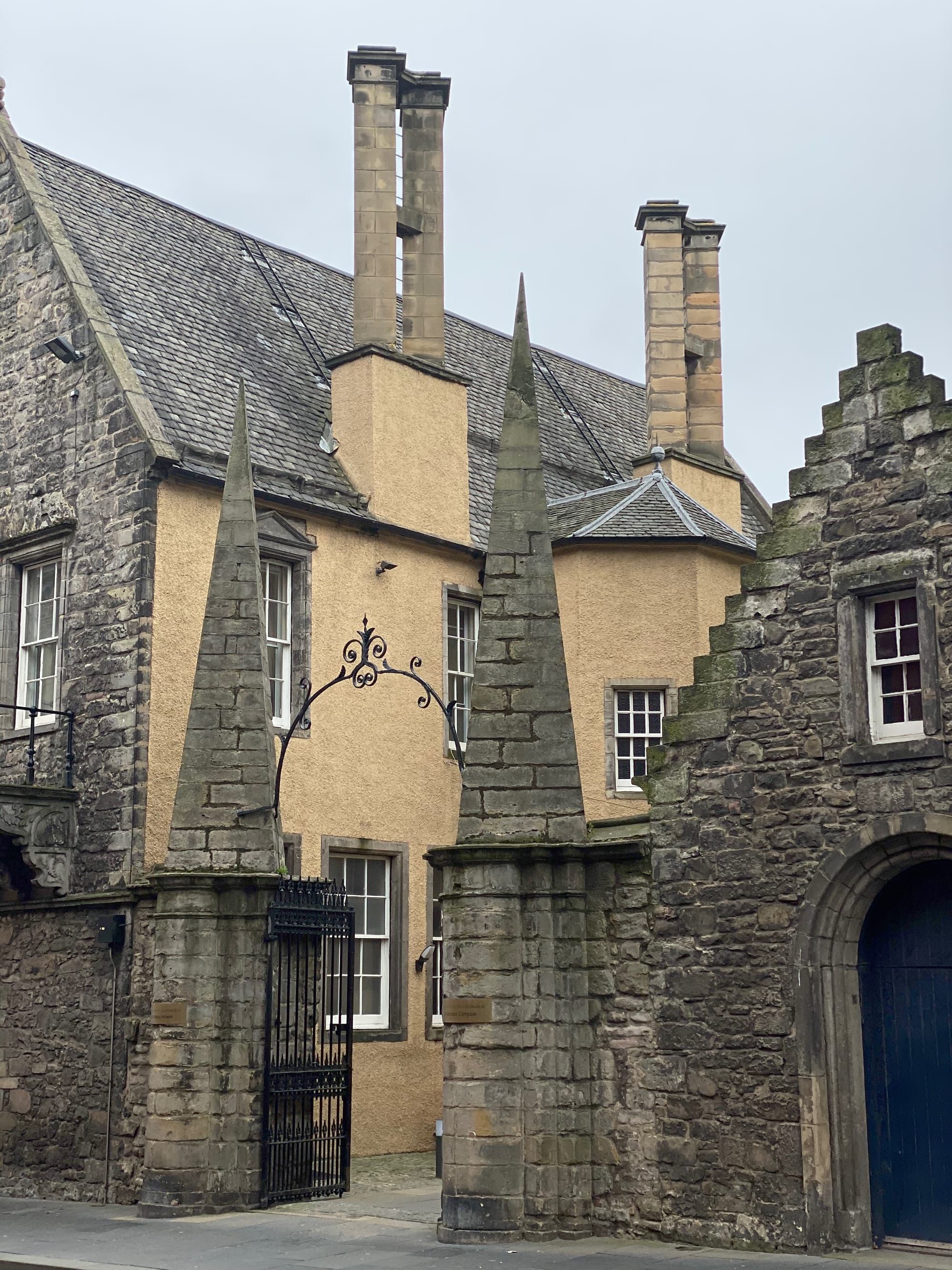
Old Moray House stands on Edinburgh’s Canongate, a fine surviving seventeenth-century aristocratic mansion. Built around 1625 for Mary, Dowager Countess of Home, it later passed to her daughter, the Countess of Moray. Today it forms part of the University of Edinburgh.
Flanking the entrance are two extraordinary late-seventeenth-century gateposts: clustered stone shafts rising into elongated, needle-like pyramids. They have something of the Northern Renaissance about them - classical authority sharpened into a restless silhouette.
Their scale establishes a kind of hierarchy along the street. These are not merely posts supporting a gate; they proclaim that the building beyond matters. The eye is drawn upwards, forced to negotiate a sequence of uprights, diagonals and emphatic triangular points.
There is psychogeography in those shapes: solidity becoming aspiration, weight becoming threat. They challenge the passer-by, turning an entrance into an announcement.
Connect with me on: Bluesky / Instagram / Facebook / X / Tumblr / Flickr / Vimeo / Pixelfed / Pinterest


Member discussion